
Executive Summary
The European Fire Prevention & Rural Preservation Organization (EFPRP) conducted the 2025 “Wildfire Safety in Europe: Public Perception” survey to evaluate how Europeans perceive wildfire risk, prevention measures, and readiness at local and national levels.
From 3,706 respondents across Greece, France, Andorra, Bosnia and Herzegovina, and Spain reveal a Europe that is deeply concerned, underprepared, and calling for stronger cooperation.
Residence and Demographics
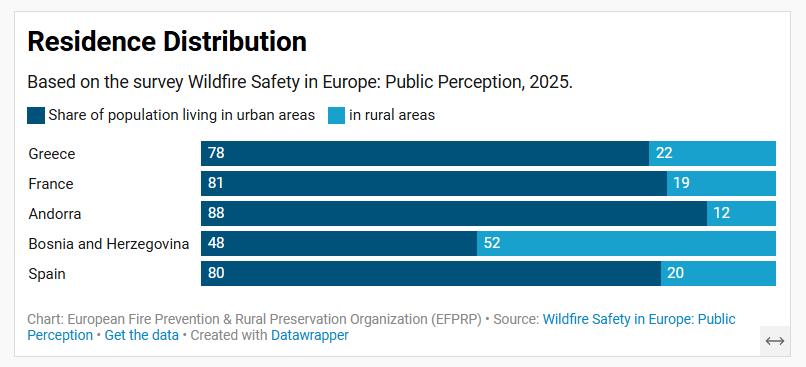
More than three-quarters of respondents (74%) live in urban areas, while 26% live in rural communities, the latter being most exposed to direct wildfire risk.
Urban populations dominate in France, Andorra, and Spain.
Bosnia and Herzegovina shows the highest rural representation (52%).
Possible interpretation: This rural-urban contrast shapes perceptions: rural respondents are more aware of local hazards but less confident in prevention measures and safety systems.
Concern About Wildfire Risk
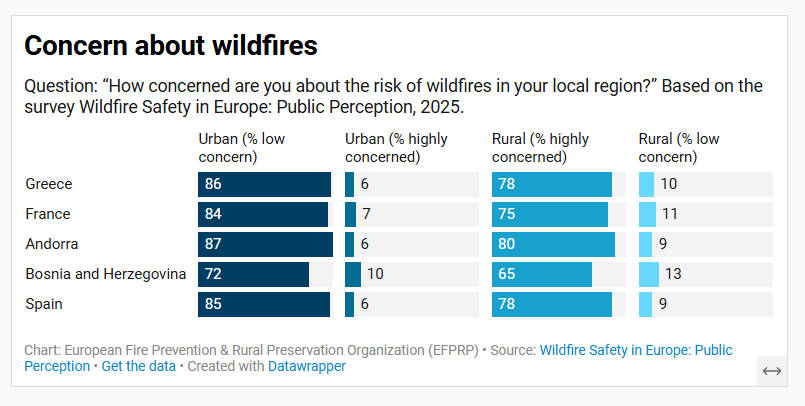
Across all countries, over 80% of urban and around 75% of rural residents said they are “highly concerned” about wildfire risk.
Greece and Andorra lead with 86–87% of urban respondents expressing extreme concern.
Bosnia and Herzegovina shows the lowest but still elevated concern (65–72%).
Possible interpretation: The findings underline that wildfire anxiety is not limited to Mediterranean regions, it is a continent-wide concern.
Perceived Effectiveness of Prevention Measures
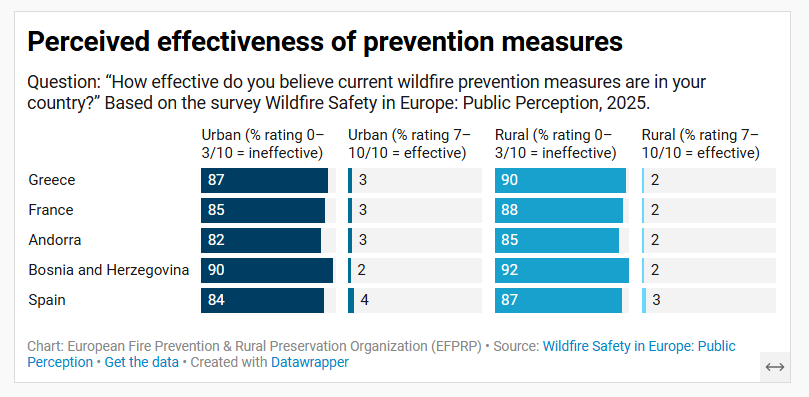
Perceptions of institutional prevention remain critically low:
87% of urban and 90% of rural respondents rated wildfire prevention 0–3/10 (ineffective).
Only 2–4% believe current efforts are effective.
Possible interpretation: Respondents think inconsistent land management, lack of local preparedness, and slow cross-border cooperation are key reasons.
Confidence in Safety if Wildfire Strikes
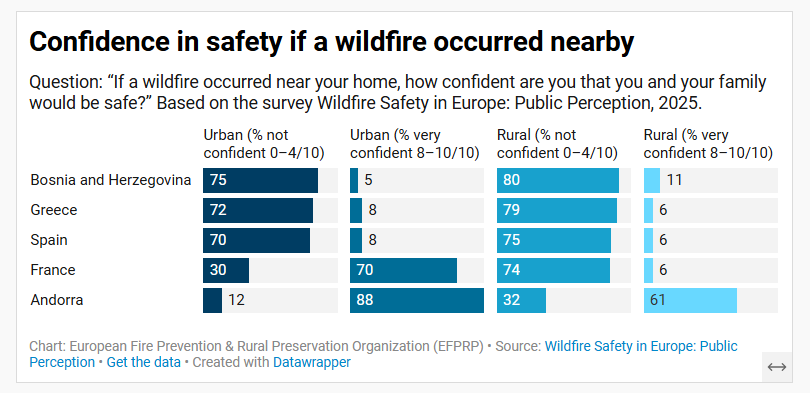
Confidence in personal or family safety is alarmingly low:
Urban: 70–75% feel “not confident” (0–4/10).
Rural: 74–80% feel “not confident,” reflecting limited evacuation options and emergency access.
Possible interpretation: Andorra’s respondents report higher confidence, likely due to smaller territory and more centralized emergency coordination.
Familiarity with Evacuation Plans
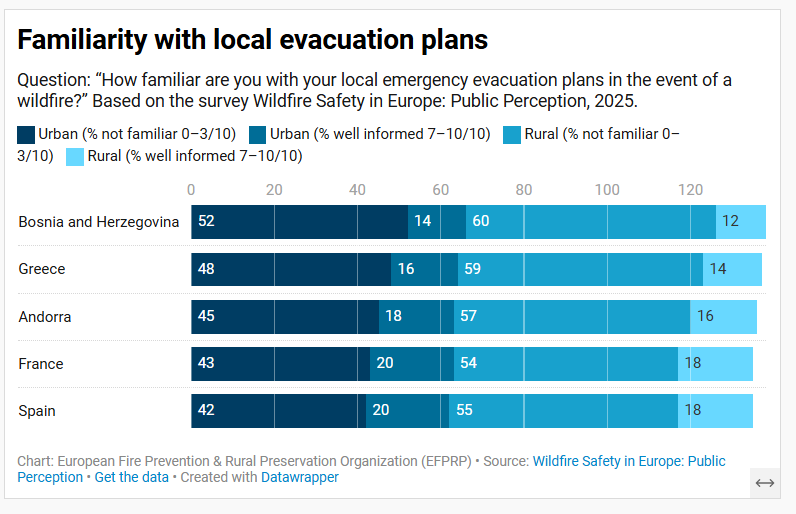
Less than 1 in 5 respondents in any country claim to be well-informed about evacuation procedures.
Urban: 16–20% say they know the plan.
Rural: only 12–18% do.
Bosnia and Herzegovina ranks lowest (12% rural, 14% urban well-informed).
Possible interpretation: This could show a critical awareness gap that directly impacts survival outcomes.
Perception of European Coordination
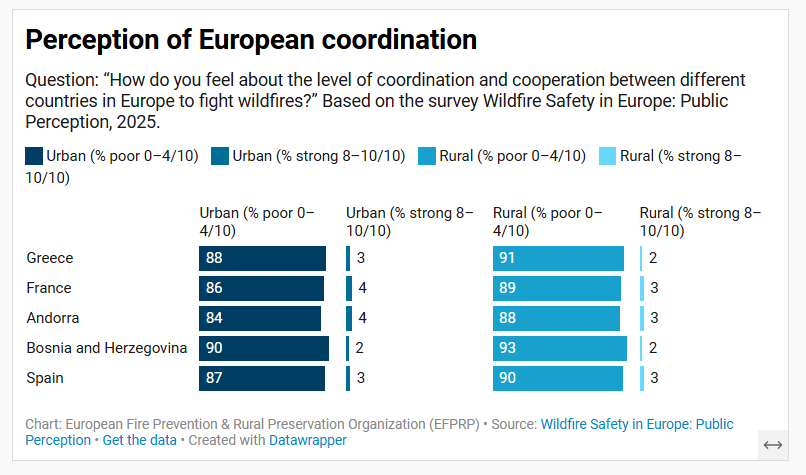
A striking 86–93% of all respondents perceive poor European coordination on wildfire management.
Rural populations were the most critical (up to 93% in Bosnia and Herzegovina).
Possible interpretation: Respondents emphasize the need for an EU-wide joint firefighting strategy, shared funding mechanisms, and rapid mutual aid protocols, although, this already exists and happens regularly, usually between June - August, where different countries send firefighters, vehicles and equipment to a wildfire in another European country, but, so far, this hasn't been proven to be really effective in prevention.
Community Action
Actual local engagement remains low:
Urban: 35–40% report no personal or community action taken.
Rural: up to 49% say they have not acted, despite being most exposed.
Possible interpretation: Only a small minority (≤18%) report active, regular mitigation efforts (vegetation clearing, firebreaks), in Spain. This could highlight the need for education, community programs, and local incentives.

Perceived Causes of Wildfires
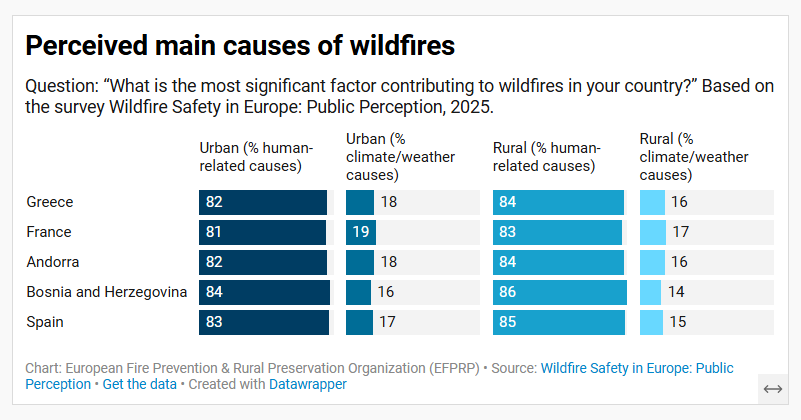
An overwhelming majority identify human activity as the primary cause:
82–84% of urban and 84–86% of rural respondents blame human negligence or arson.
Only 14–19% cite climate or weather as dominant.
Possible interpretation: This could demonstrate that public perception attributes fires largely to preventable human factors, supporting the case for stricter safety regulation and awareness campaigns.
Funding Adequacy
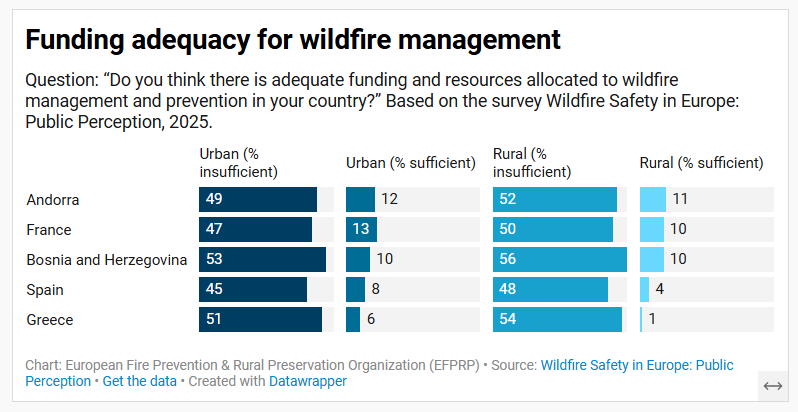
Respondents largely agree that funding for wildfire management is insufficient:
Urban: 45–53% say funding is “inadequate.”
Rural: 48–56% share the same view.
Possible interpretation: Even in wealthy nations such as France and Andorra, only about 10–13% believe resources are sufficient.
Willingness to Contribute
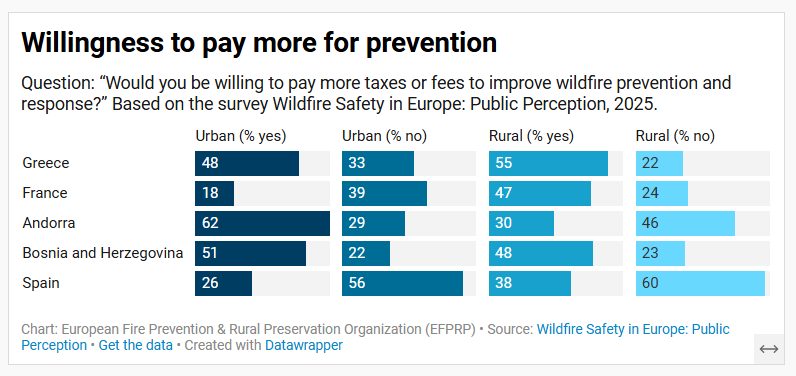
Half of Europeans say they would be willing to pay higher taxes or fees to fund better wildfire management and prevention.
Support is strongest in Andorra (max. 62%) and Bosnia and Herzegovina (max. 51%),
lowest in Spain (min. 26%) and France (min. 18%).
Possible interpretation: This could reflect both public frustration and readiness to participate financially in safety measures.
Summary: Possible Global Interpretation of the Results
The findings from this survey may reflect not only environmental concerns, but, also a broader socio-economic and institutional context for each stated country.
To firstly address Greece: in Greece, the combination of recurring heatwaves, limited public resources, and rural depopulation has enhanced, both, anxiety and skepticism toward national preparedness systems.
On another side, France, with its strong administrative capacity but increasingly severe southern wildfires, shows a population that expects more efficiency from public institutions.
Now, in Spain, a country familiar with large seasonal fires, respondents’ high concern yet moderate willingness to pay more may stem from economic pressures and a well known long standing expectation that the state should lead prevention efforts.
Andorra’s relatively high confidence in safety and awareness of evacuation procedures are likely explained by its small scale, centralized governance, and strong urban planning.
Conversely, Bosnia and Herzegovina’s low confidence and limited community action could be linked to low public funding, and uneven institutional coordination.
All of this put together, show us that perceptions of wildfire risk are shaped as quit as much by governance quality and economic stability as by exposure to the fires themselves. Usually, countries with higher institutional trust show more belief in preparedness but still demand regional cooperation.